Data_Sea
v1.0 by: Michael Takeo Magruder with Drew Baker, Johanna Jarvis & David Steele, 2009
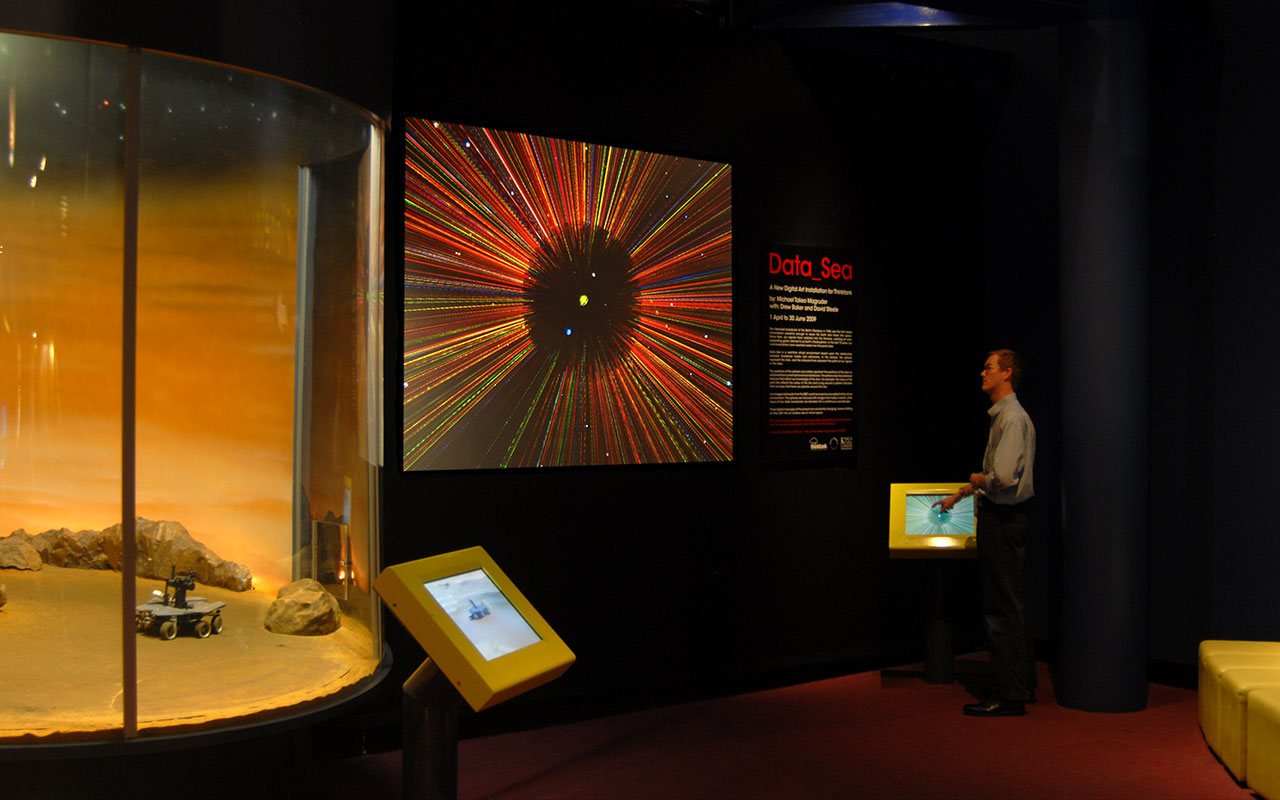
A networked, real-time 3D installation exploring the relationship between astronomy and broadcast media.
About the Artwork:
The televised broadcast of the Berlin Olympics in 1936 was humanity's first media transmission powerful enough to pass through Earth's ionosphere and travel into deep space. From that point in time our signals have radiated into the universe, creating an ever-expanding globe referred to as Earth's Radiosphere. In the 73 years since that defining moment, our communications have reached nearly two thousand other known star systems.
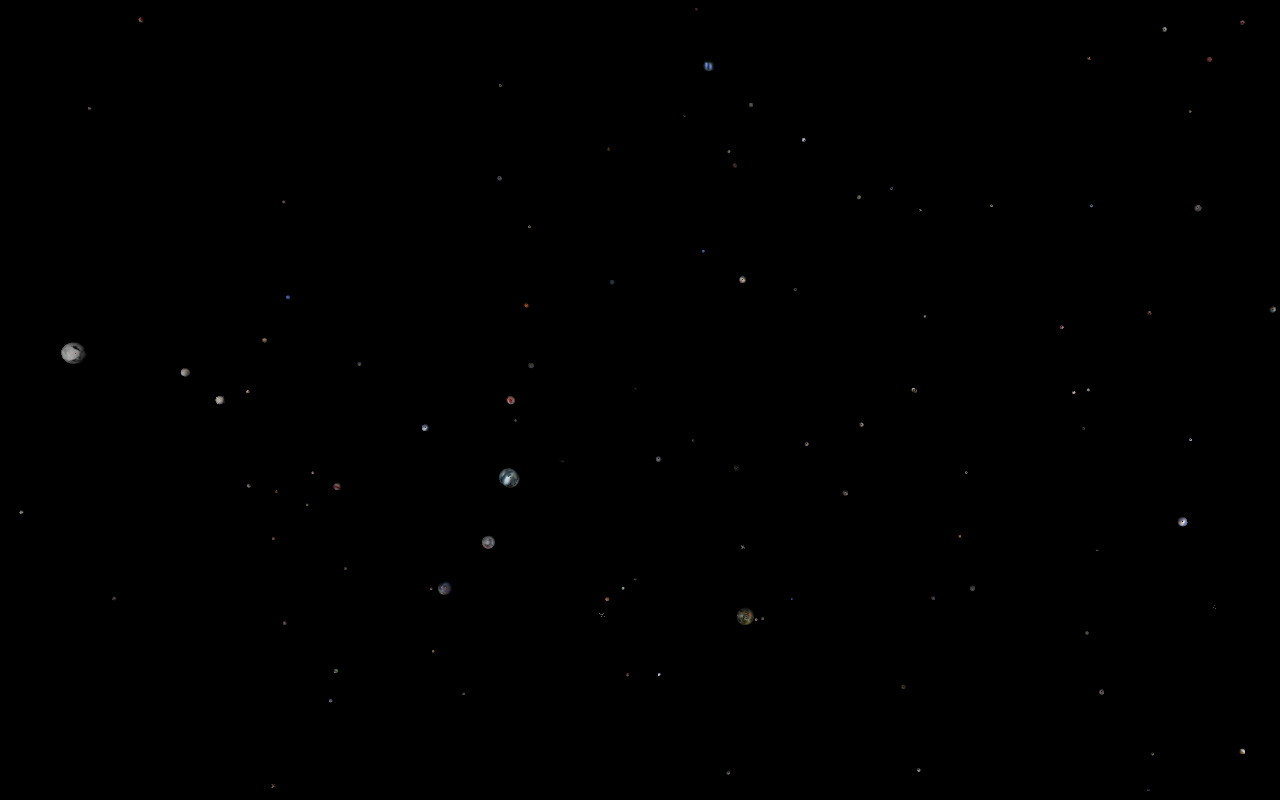
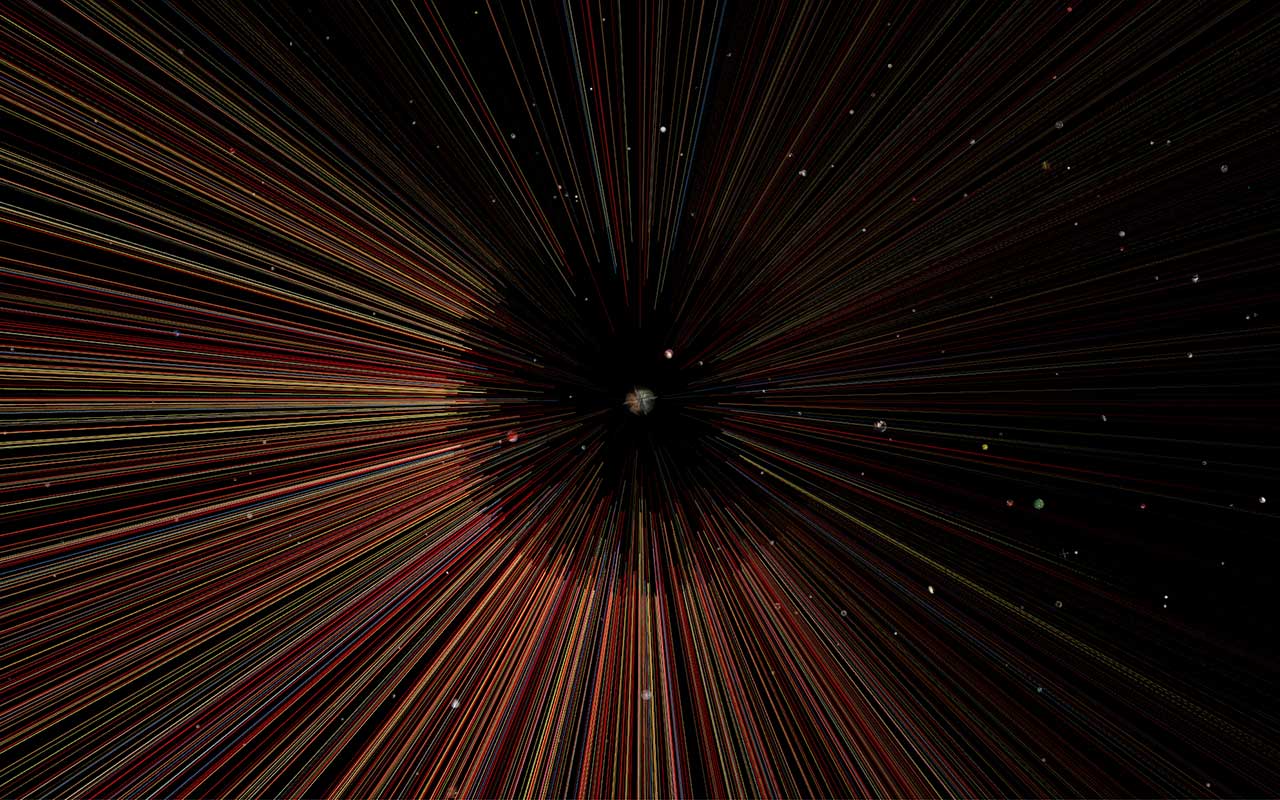
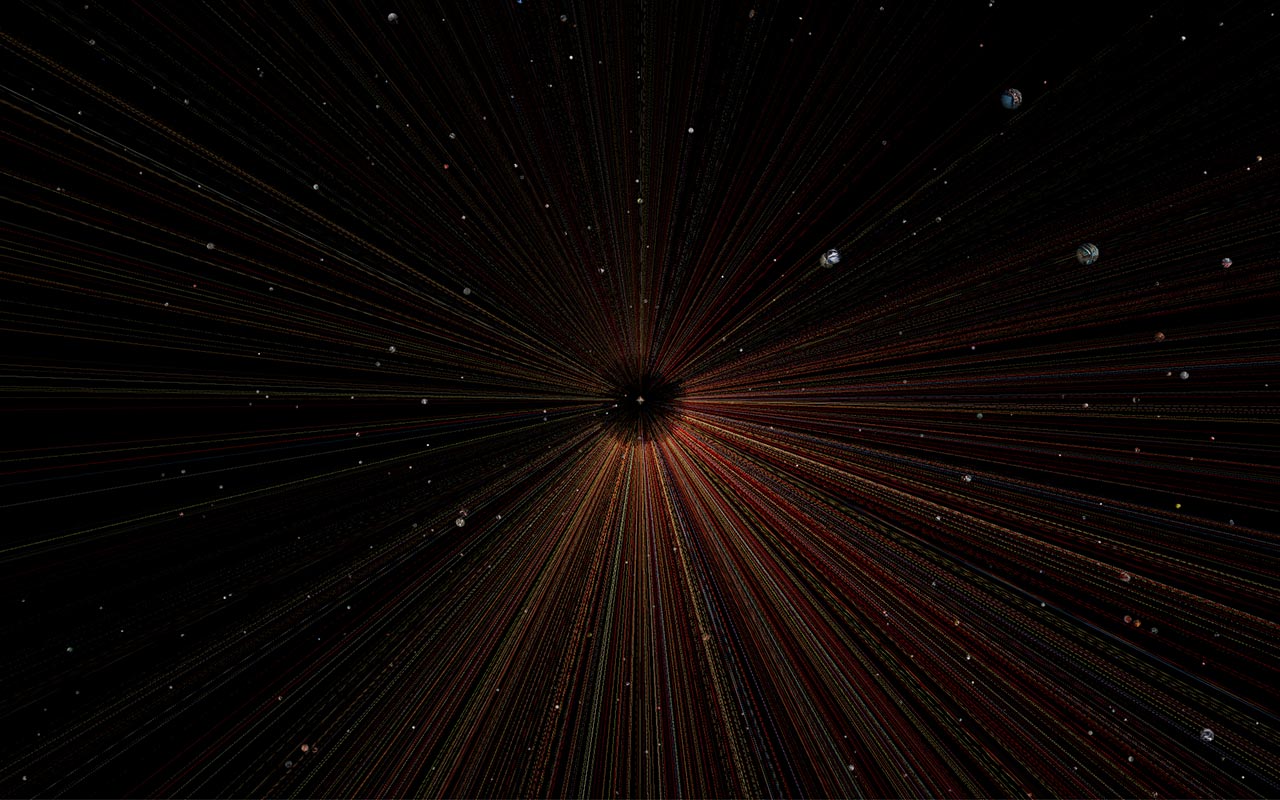
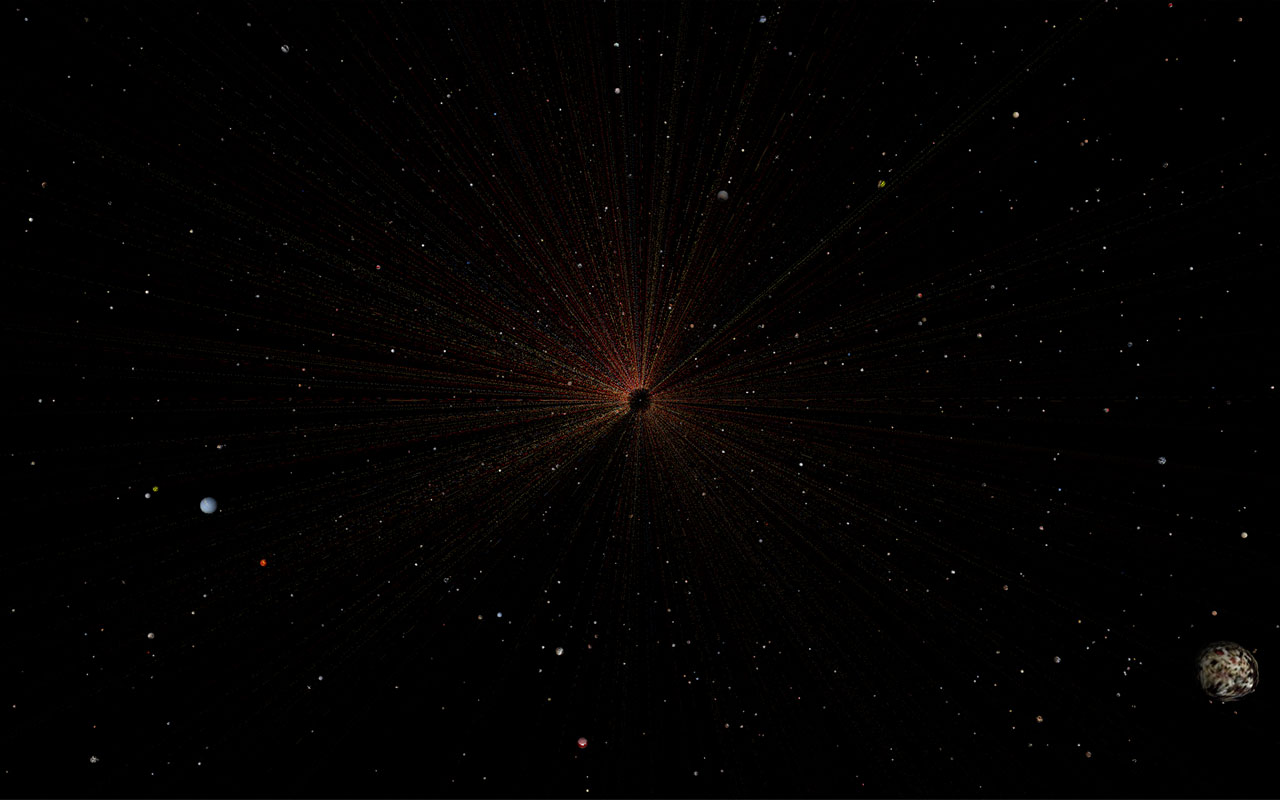
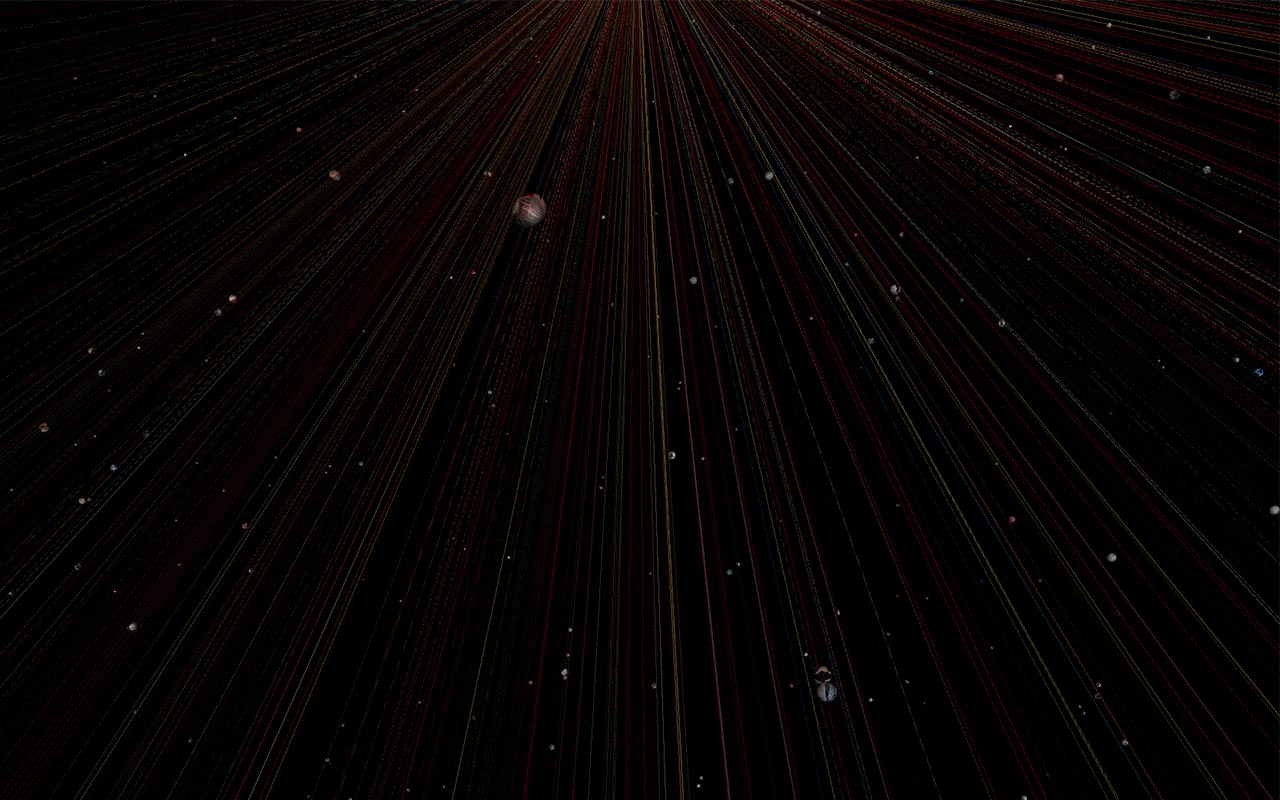
Data_Sea is a real-time virtual environment based upon this relationship between broadcast media and astronomy. The core geometry of the artwork is directly derived from the actual positions of all catalogued star systems residing within the Radiosphere. Obtained from current astronomical databases such as the Hipparcos star catalogue, these scientific measurements have been translated into a three-dimensional structure constructed in Virtual Reality Modelling Language (VRML).
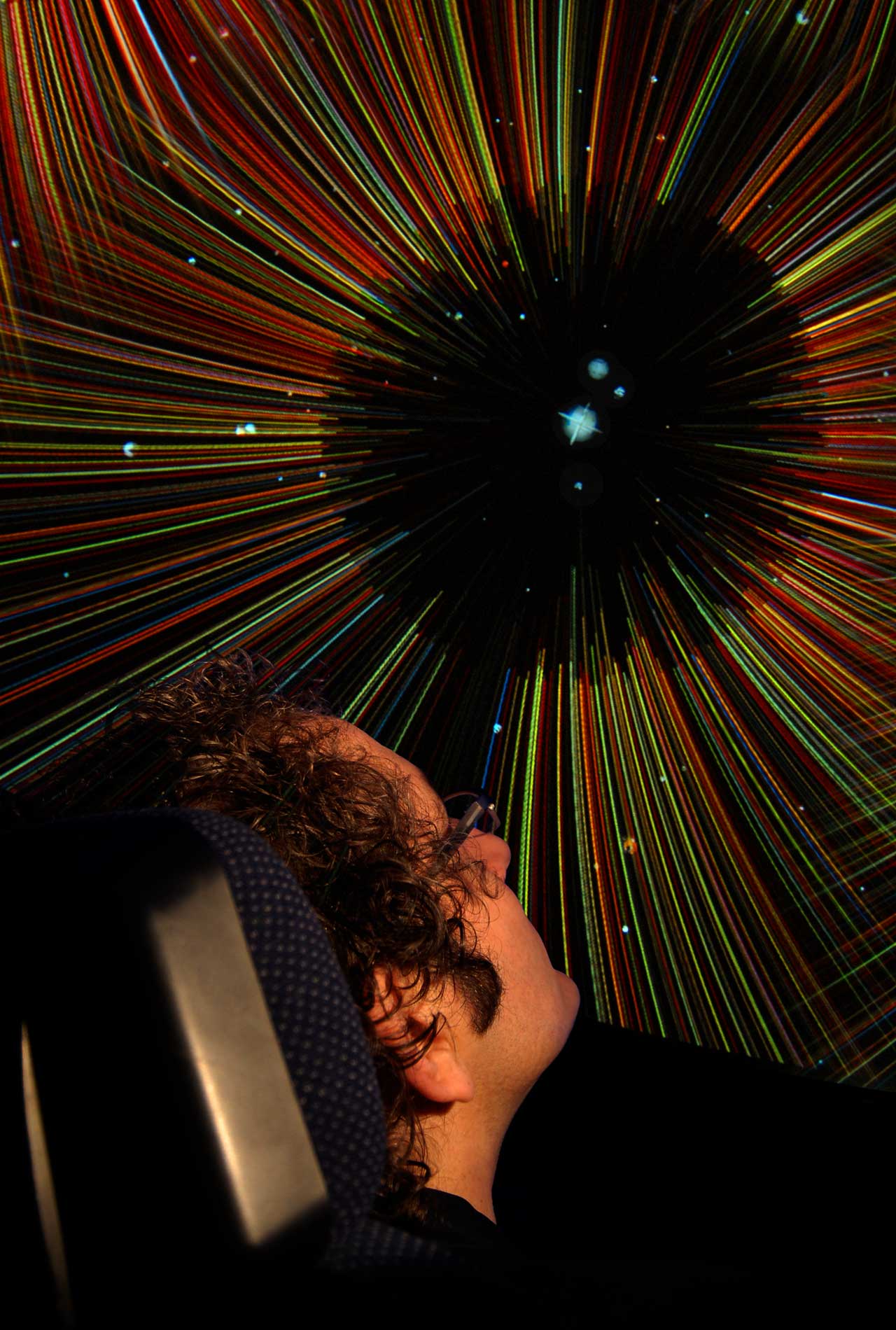
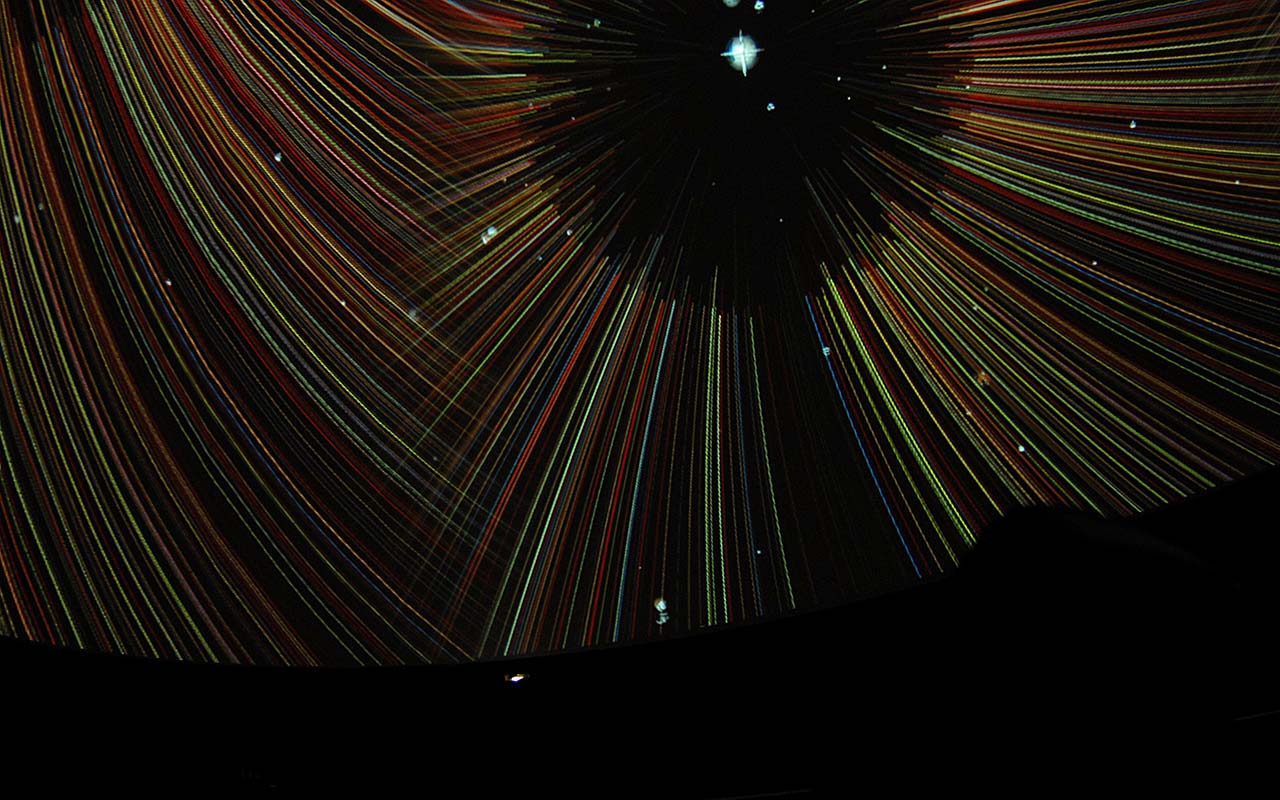
Each star system's basic properties affect its aesthetic manifestation within the virtual realm. Star type is represented by shape, with normal stars appearing as full spheres, 'failed' stars (brown dwarfs) as incomplete spheres and 'dead' stars (white dwarfs) as compressed crosses. The stellar nodes are connected to a central spherical body (representing our solar system) by line structures that are coloured according to spectral class of the individual stars. Systems that are known to contain exoplanets are surrounded by concentric ring structures.
Live media from the BBC world news service is streamed into the environment. The virtual elements are textured with images from today's events, while layers of live audiocasts are blended into a persistent soundscape. These mediated reflections of the present are in constant flux, forever shifting as they drift into an endless sea of virtual space.
Artwork Documentation:
In Collaboration with:
Drew Baker [ VRML programming ] . Johanna Jarvis [ scientific research ] . David Steele [ backend programming ]
With Thanks to:
Mario Di Maggio & Clara Lim [ curation ] . Emma Puente [ project co-ordination ]
Supported by:
Data_Sea v1.0 was commissioned and produced in 2009 for the International Year of Astronomy by Thinktank, Birmingham Science Museum with funds from Arts Council England and generous support from King's Visualisation Lab, Centre for Computing in the Humanities, King's College London and ParallelGraphics.
Installation Documentation:
Artwork Requirements:
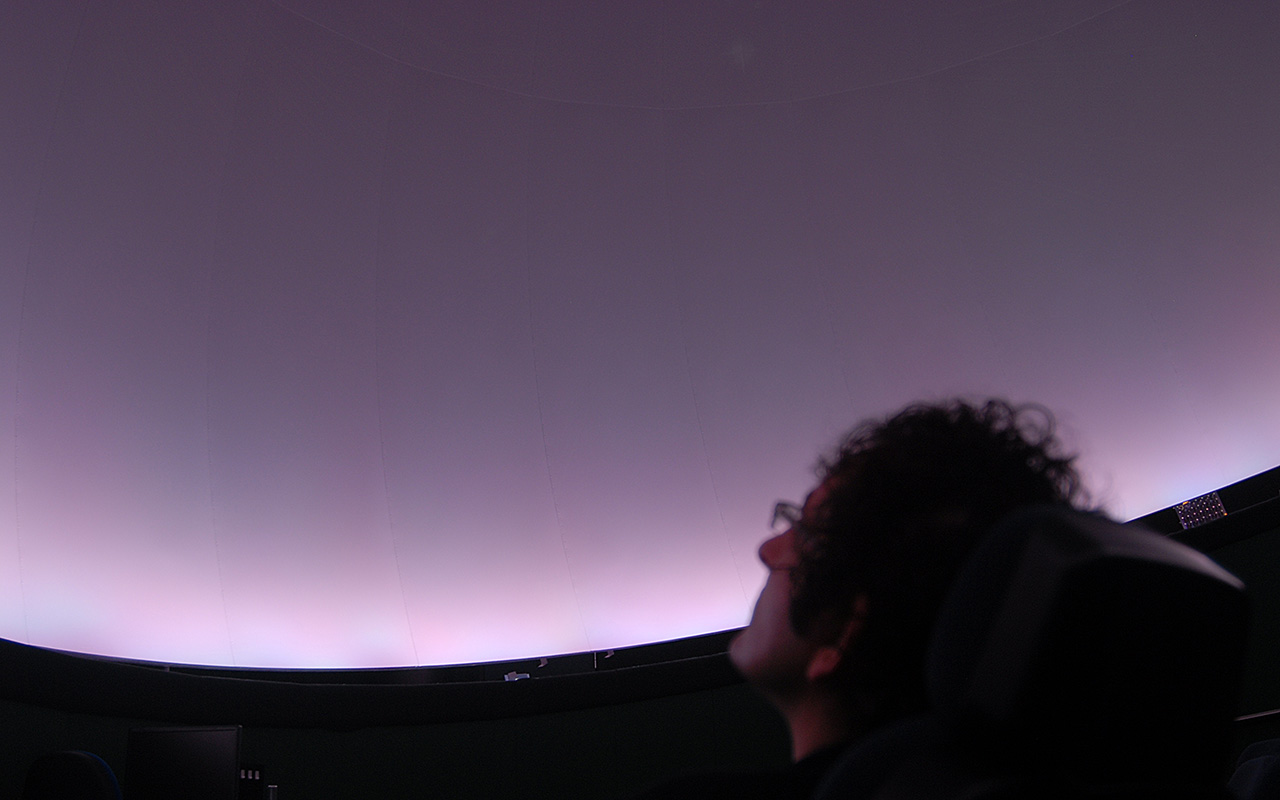
[ gallery ] High-specification Windows 7/8/10 computer system capable of real-time high definition 3D rendering (VRML and Flash); fulldome (360°) projection environment or multi/single-channel high definition video system; 5.1/2.1 audio system; and HCI device for user interaction.
[ online ] Windows 7/8/10 computer system with Firefox or Internet Explorer; the Cortona3D Viewer and Adobe Flash plugins; and stereo audio. A high-specification CPU/GPU, colour display with ≥1024x768 resolution and high-speed Internet connection are recommended.
[ VIEW THE ARTWORK (Windows - Firefox/Internet Explorer) 3MB ]
* The Cortona3D Viewer is not available for OS X and Linux. On these systems FreeWRL can be used to render most aspects of the work.
* In April 2015 Google deprecated support for NPAPI plug-ins (including Cortona3D Viewer). As such, VRML works can no longer be viewed using Chrome.